Fermions and the Fifth Dimension: Could Dark Matter Be Hiding in a Warped Extra Dimension?
The Dark Matter Problem: A Cosmic Mystery
Dark matter is one of the most perplexing mysteries in modern physics. It makes up approximately 75% of all matter in the universe, yet we've never directly observed it. We know it exists because of its gravitational effects—galaxies rotate faster than they should, and cosmic structures form in ways that only make sense if there's invisible matter providing additional gravitational pull.
Despite decades of searching with increasingly sophisticated detectors, dark matter particles have remained completely elusive. This has led physicists to explore increasingly creative theoretical frameworks, including the possibility that dark matter might not exist in our familiar three-dimensional space at all.
The Warped Extra Dimension Model
In a groundbreaking study published in The European Physical Journal C, scientists from Spain and Germany have proposed a radical solution: dark matter could be the result of fermions pushed into a warped fifth dimension.
This theory builds on the "Warped Extra Dimension" (WED) model, first introduced in 1999. The WED model was originally developed to solve the "hierarchy problem"—the question of why the Higgs boson is so much lighter than the characteristic scale of gravity. But this new research is the first to cohesively use the WED framework to explain dark matter.
Understanding Fermions: The Building Blocks of Matter
Fermions are a class of fundamental particles that include electrons, quarks, and neutrinos—essentially, all the particles that make up ordinary matter. They follow the Pauli exclusion principle, which prevents identical fermions from occupying the same quantum state. This is why matter has structure: electrons can't all collapse into the lowest energy state, creating the diverse chemical elements we observe.
In the new theoretical framework, fermions with specific mass properties could be "communicated" into a fifth dimension through what the researchers call "portals." These fermions would then exist in a warped, five-dimensional space, creating what the scientists term "fermionic dark matter."
The Fifth Dimension Portal
The concept of extra dimensions isn't new—string theory, for example, requires 10 or 11 dimensions. However, the WED model is unique in how it warps the extra dimension. In this framework, the fifth dimension isn't flat like our three spatial dimensions; instead, it's warped or curved, creating a "bulk" where particles can exist with different properties than they would in our four-dimensional spacetime.
When fermions pass through the portal into this warped fifth dimension, they gain bulk masses that manifest differently than they would in standard four-dimensional space. This creates a "dark sector"—a hidden realm of particles that interact with our universe primarily through gravity, explaining why dark matter has been so difficult to detect.
Beyond the Standard Model
The Standard Model of particle physics has been incredibly successful, accurately predicting the behavior of particles and forces in countless experiments. However, it has significant gaps:
As the researchers note: "We know that there is no viable [dark matter] candidate in the [Standard Model of physics], so already this fact asks for the presence of new physics."
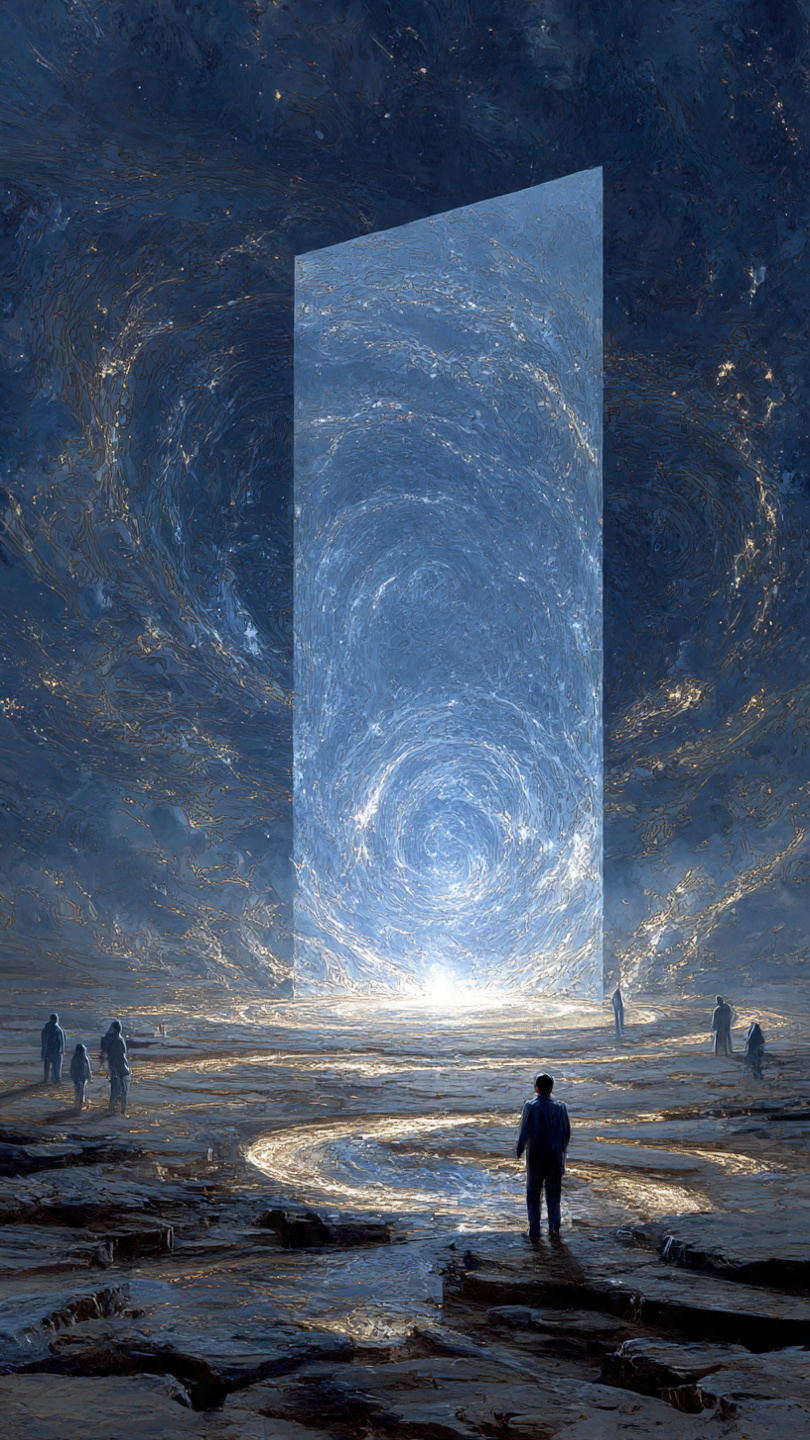
The fermion portal to a fifth dimension represents one possible extension of physics beyond the Standard Model—a way to explain dark matter while also addressing the hierarchy problem.
How Could We Detect Fermionic Dark Matter?
One of the most exciting aspects of this theory is that it might be testable. The researchers suggest that gravitational wave detectors could potentially identify fermionic dark matter in the warped fifth dimension.
Gravitational wave observatories like LIGO (Laser Interferometer Gravitational-Wave Observatory) and Virgo have already revolutionized our understanding of the universe by detecting ripples in spacetime caused by massive cosmic events like black hole mergers. Future, more sensitive gravitational wave detectors could potentially detect signatures of dark matter particles interacting in the fifth dimension.
Additionally, particle accelerators like the Large Hadron Collider (LHC) could search for evidence of the portal mechanism itself—signs that fermions are interacting with extra dimensions.
Implications for Our Understanding of Reality
If this theory proves correct, it would fundamentally change our understanding of the universe. We would live in a five-dimensional reality, with most of the matter in the universe existing in a dimension we can't directly perceive. This would be similar to how a two-dimensional being on a flat surface couldn't perceive the third dimension, even though objects in 3D space could affect their 2D world through gravity.
The warped extra dimension would create a natural explanation for why dark matter is so abundant yet so difficult to detect: it's not hiding in our three-dimensional space—it exists in a separate dimensional realm, connected to ours through gravitational portals.
The Path Forward
While this theory is compelling, it's important to remember that it's still theoretical. The researchers have shown that the mathematics works—that fermions in a warped fifth dimension could account for dark matter—but experimental verification is the next crucial step.
As gravitational wave detectors become more sensitive and particle accelerators probe higher energies, we may finally find evidence for extra dimensions and solve the dark matter mystery. The answer, as the researchers suggest, could indeed be "lurking around the corner."
This research represents a beautiful example of how theoretical physics pushes the boundaries of our understanding, proposing radical solutions to seemingly intractable problems. Whether or not dark matter turns out to be fermions in a fifth dimension, exploring these ideas expands our knowledge of what might be possible in our universe.
Conclusion: A New Window into Hidden Dimensions
The idea that dark matter could be fermions existing in a warped fifth dimension is both elegant and revolutionary. It solves multiple problems at once: explaining dark matter, addressing the hierarchy problem, and providing a framework for physics beyond the Standard Model.
As we continue to push the boundaries of experimental physics with gravitational wave detectors and particle accelerators, we may soon discover whether this theoretical framework describes reality. If it does, we'll have opened a window into dimensions beyond our perception, revealing that the vast majority of matter in the universe exists in a realm we've only just begun to explore.
The universe, it seems, may be far more complex—and far more interesting—than we ever imagined.


💬 Comments (0)
Share your thoughts and join the discussion
Please log in or register to leave a comment.
No comments yet. Be the first to share your thoughts!